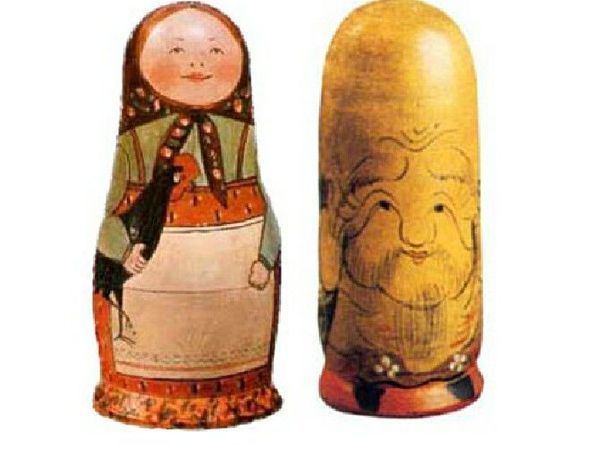

Artists at Abramtsevo had been working to revive traditional folk crafts and designs; they were conducting an ethnographic study of Russian peasant costumes and creating dolls dressed accordingly, an endeavor that influenced the creation of the matryoshka. But another key influence was a Japanese nesting kokeshi doll that Elizaveta Mamontova, the wife of industrialist and art patron Savva Mamontov (owner of Abramtsevo), brought back from the island of Honshu and showed to Malyutin. [Image: Matryoshka and kokeshi doll. The doll that Mamontova showed to Malyutin depicted a wise old man with a very tall forehead. Kokeshi dolls themselves have Chinese origins—the Chinese made nesting boxes and eventually started making dolls using the same design principle.] This origin story, with its merging of Russian and Japanese design, speaks of the plurality/hybridity of Russian identity, even in cases of things people tend to see as quintessentially Russian.
